
Why I Built Klaris: A Founder’s Story
The founder's story behind Klaris: how a software engineer and math nerd escaped spreadsheet hell to build the ultimate, integrated personal finance app.
For years, my quarterly financial review process with my wife followed a predictable, frustrating script. We would sit down with the best intentions, aiming to make strategic, forward-looking decisions about our lives. Instead, we’d spend hours copy-pasting numbers across a fragmented web of spreadsheets and tools just to get our data straight. By the time we actually had accurate numbers, we were too exhausted to make any real progress.
I built Klaris to solve this exact problem. I wanted a personal finance tool that seamlessly unified the three major pillars of wealth management: daily spending, long-term financial forecasting, and real-life decision-making.
Here is the founder's story of how a software engineer and applied math nerd set out to build the exact financial platform he couldn't find on the market.
Investing is Confusing
To understand why Klaris exists, you have to understand my background. I have spent my entire professional career as a software engineer, and my academic roots are in applied mathematics. I’ve written my fair share of numerical and statistical software, which means I naturally want to understand exactly what assumptions a tool is making under the hood.
Yet, despite my technical background, personal finance and investing long felt like an impenetrable black box. Like most people, I was never taught this in school. My investing was limited to a workplace 401(k) that felt vaguely risky, something I did simply because older, more experienced people told me to.
As my career progressed and my income grew, I did what many busy professionals do: I hired an assets under management (AUM) financial advisor. While they were on the lower end of the fee spectrum, it still irked me to see that hard-earned money leave my account every quarter. Once I looked closely at the portfolio they built for me, I had an epiphany: this wasn't actually that complicated.
The Boglehead Pivot and the Spreadsheet Nightmare
I fired my advisor and took matters into my own hands, diving deep into the Bogleheads philosophy, a community inspired by Vanguard founder John Bogle that advocates for low-cost, passive index fund investing.
While the philosophy is simple, the execution is surprisingly difficult. As my career progressed, my financial footprint grew. I found myself managing money across multiple accounts:
- A taxable brokerage account
- Traditional and Roth IRAs
- Active and old employer 401(k) accounts
This is where passive investing gets highly error-prone. To maintain a target asset allocation (say, 80% stocks and 20% bonds, with a specific split between domestic and international), you have to look across all accounts as one cohesive portfolio.
Calculating this manually in a spreadsheet meant digging into the underlying holdings of target-date funds and diversified ETFs. It was tedious, stressful, and begged for automation.
What Klaris Does Differently
I built the Klaris app to be the tool I desperately needed, a mathematically rigorous, beautifully designed platform that acts as a bridge between your current cash flow and your future wealth. Here are the core pillars we built into Klaris:
1. Frictionless, Multi-Account Rebalancing
Klaris looks at your entire portfolio across all account types to calculate your exact asset allocation. When it’s time to rebalance, Klaris doesn't just tell you what's out of alignment; it tells you the exact trades to make. Even better, you can toggle smart rules, such as avoiding taxable events in your brokerage account and prioritizing rebalancing movements within tax-advantaged accounts (like your 401(k) or IRA).
2. A Real-Time Financial Health Check-up
Klaris connects your daily cash flow directly to your retirement trajectory. By linking your actual spending to advanced retirement forecasters and drawdown calculators, you can see exactly how much you are likely to have, on what timeline, and how long your nest egg will last.
3. Infinite "What-If" Scenario Testing
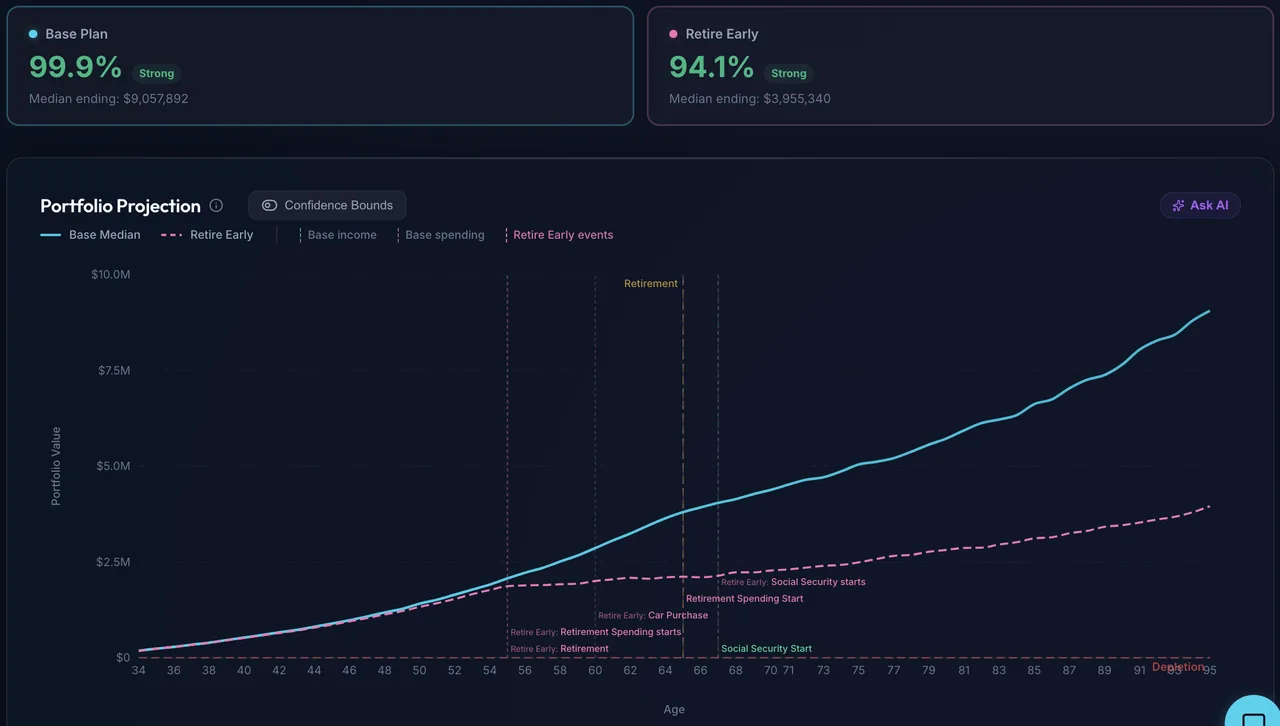
My wife and I constantly ask questions like: "What if one of us drops down to part-time work?" or "What if we take a career sabbatical, how does that impact our retirement trajectory?"
Klaris features a purpose-built scenario calculator that lets you test these ideas against your base financial plan. You can instantly see how lifestyle changes stack up over a multi-decade horizon and seamlessly compare those to your current plan to see how things change.
4. Transitioning to a "Conscious Spending Plan"
I am a massive fan of Ramit Sethi’s philosophy of reframing rigid, restrictive budgeting into a "Conscious Spending Plan" (CSP). Klaris is designed to support this exact mindset. Instead of feeling guilty about every cup of coffee or even more significant treats you buy yourself, Klaris helps you automate your fixed monthly costs and long-term savings so you can confidently allocate your remaining funds to "guilt-free" discretionary spending. I built the exact tool I wanted to make it easy to set up a CSP and track all your numbers in that same style.
Take Control of Your Financial Future
You shouldn't have to choose between expensive, black-box financial advisors and a chaotic web of manual spreadsheets. Klaris was built to give you total clarity, mathematical accuracy, and peace of mind over your wealth.
Whether you are a seasoned index investor or just starting to take control of your asset allocation, Klaris is built for you.